微积分I(标准路径) · free preview
MIT 18.01 Practice Exam 3B
Practice exam for Unit III: half-angle identities and integrals, functions defined by integrals, trapezoidal and Simpson's rules.
1. MIT 18.01 Practice Exam 3B — how this assessment works
This lesson reproduces the Practice Exam “MIT 18.01 Practice Exam 3B” from MIT OpenCourseWare 18.01 Single Variable Calculus (Fall 2006) (https://ocw.mit.edu/courses/18-01-single-variable-calculus-fall-2006/), licensed under CC BY-NC-SA 4.0. Work through 6 problems in order: type your reasoning in the answer box or write it on the handwriting pad, then submit for AI grading.
How the grading works Every problem is graded by an AI mathematics teacher that reads the official solution shipped with the course. It checks your work criterion by criterion, awards partial credit for correct steps, and returns written feedback. Equivalent mathematics and valid alternative methods are accepted — a different route to the same result can still earn full marks.
If your answer is incomplete, the feedback names exactly which steps are missing, so you can correct them and try again.
2. MIT 18.01 PE3B Problem 1 — Half-angle identity and the integral of ln x (10 + 10 pts)
a) (10) Derive the trigonometric formula and use it to evaluate .
b) (10) Differentiate , and use your answer to evaluate .
3. MIT 18.01 PE3B Problem 2 — The Great Pumpkin (volume of a solid of revolution) (15 pts)
K-mart is selling at half-price its left-over Great Pumpkins — thin orange plastic shells filled with half-price Halloween candy.
A Great Pumpkin has the shape of the curve , rotated about the vertical axis, i.e., the -axis. This curve is symmetric about the -axis and the -axis — it looks something like a circle, but somewhat flatter at the top and bottom.
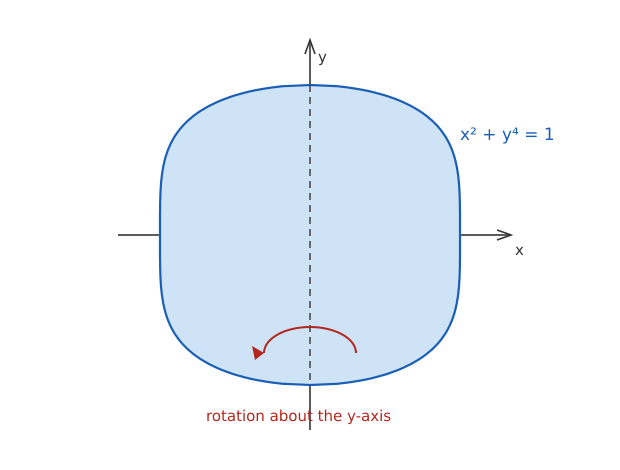
Using units in feet, how many cubic feet of candy will it take to fill a Great Pumpkin? Give the exact answer, then tell if 5 cubic feet will be enough.
4. MIT 18.01 PE3B Problem 3 — The non-elementary function $F(x)=\int_0^x t^2e^{-t^2}dt$ (20 pts: 3 + 7 + 5 + 5)
(20: 3,7,5,5) The function is not elementary; it comes up in calculating the standard deviation of The Curve of normal distribution. (In the following, (a) and (b) go together, but (c) and (d) are both independent questions.)
a) Find .
b) Find the critical point(s) of , and determine their type(s) by studying the sign of when is near a critical point.
c) Express in terms of values of .
d) Estimate by showing that , if .
5. MIT 18.01 PE3B Problem 4 — AllSoy SmartHam: the average area of a slice (15 pts: 12 + 3)
(15: 12, 3) The end portion of a boneless AllSoy SmartHam of length has approximately the shape of the region under the curve , , rotated about the -axis.
a) When it is sliced vertically into thin slices, what is the average area of a slice?
b) Where on the SmartHam is there a slice having this average area (i.e., how far from the tip)?
6. MIT 18.01 PE3B Problem 5 — Pepe LeMoko's hits: trapezoidal and Simpson's rules (15 pts: 7 + 8)
(15: 7,8) You only have time to look at the newspaper on Sunday, but the first thing you turn to is the baseball statistics from Saturday's game, to see how many hits your favorite ball-player Pepe LeMoko got. In September (which started on a Saturday) he had a slump in the middle, but came out of it. His record on the five successive Saturdays was
Suppose there was a game every day; estimate the total number of hits he got during those 29 games by using
a) the trapezoidal rule
b) Simpson's rule
7. MIT 18.01 PE3B Problem 6 — Acid rain into a garden pool (setting up an integral) (15 pts)
(15) Rain falls for 10 hours on a little garden pool, increasing from a drizzle to a downpour, then tapering off to a drizzle again. The rate of raining is given by
This being the city, the rain is polluted with acid; at the start of the rain (), it contains 2 nanograms/cu.cm. of acid, but this decreases linearly to only 1 nanogram/cu.cm. by the end of the rain.
Assume the pool has an area of one square meter.
Set up, but \textbf{do not evaluate}, a definite integral which tells how many nanograms of acid are in the pool at the end of the rain. Give brief reasoning, either by dividing up the time interval into small subintervals, or by using infinitesimal time intervals.
Practice this interactively
Free account · instant grading · spaced review that schedules itself.
Start this course for free