微积分I(标准路径) · free preview
MIT 18.01 Practice Quiz 3A
Practice quiz on definite integrals and Riemann sums: substitution, upper sums, volumes and numerical integration.
1. MIT 18.01 Practice Quiz 3A — how this assessment works
This lesson reproduces the Practice Quiz “MIT 18.01 Practice Quiz 3A” from MIT OpenCourseWare 18.01 Single Variable Calculus (Fall 2006) (https://ocw.mit.edu/courses/18-01-single-variable-calculus-fall-2006/), licensed under CC BY-NC-SA 4.0. Work through 9 problems in order: type your reasoning in the answer box or write it on the handwriting pad, then submit for AI grading.
How the grading works Every problem is graded by an AI mathematics teacher that reads the official solution shipped with the course. It checks your work criterion by criterion, awards partial credit for correct steps, and returns written feedback. Equivalent mathematics and valid alternative methods are accepted — a different route to the same result can still earn full marks.
If your answer is incomplete, the feedback names exactly which steps are missing, so you can correct them and try again.
2. MIT 18.01 PQ3A Problem 1 — Two integrals by substitution
Evaluate
a)
b)
3. MIT 18.01 PQ3A Problem 2 — Definite integral as a limit of upper sums
Evaluate
directly from its definition as the limit of a sum.
Use upper sums (circumscribed rectangles). You can use the formula
4. MIT 18.01 PQ3A Problem 3 — Continuous compounding with a steady deposit stream
A bank gives interest at the rate , compounded continuously, so that an amount deposited grows after years to an amount .
You make a daily deposit at the constant annual rate ; in other words, over the time period you deposit dollars. Set up a definite integral (give reasoning) which tells how much is in your account at the end of one year. (Do not evaluate the integral.)
5. MIT 18.01 PQ3A Problem 4 — A function defined by an integral (a) 5 pts, b) 5 pts, c) 10 pts)
Consider the function defined by
Without attempting to find an explicit formula for ,
a) (5) show that ;
b) (5) determine whether is convex ("concave up") or concave ("concave down") on the interval ; show work or give reasoning;
c) (10) give in terms of values of the value of
6. MIT 18.01 PQ3A Problem 5 — Recovering the constant and the integrand
If
find the value of the constant and the function .
7. MIT 18.01 PQ3A Problem 6 — Volume of a glass vase (horizontal slices)
A glass vase has the shape of the solid obtained by rotating about the -axis the area in the first quadrant lying over the -interval and under the graph of . By slicing it horizontally, determine how much glass it contains.
8. MIT 18.01 PQ3A Problem 7 — Over-filled ice-cream cone (cylindrical shells)
A right circular cone has height and base radius ; it is over-filled with ice cream, in the usual way. Place the cone so its vertex is at the origin, and its axis lies along the positive -axis, and take the cross-section containing the -axis. The top of this cross-section is a piece of the parabola . (The whole filled ice-cream cone is gotten by rotating this cross-section about the -axis.)
What is the volume of the ice cream? (Suggestion: use cylindrical shells.)
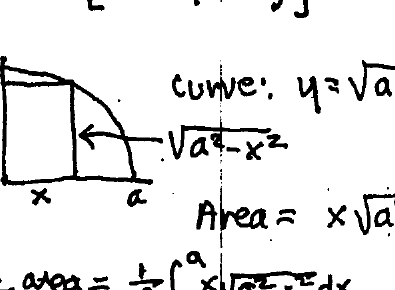
9. MIT 18.01 PQ3A Problem 8 — Average area of an inscribed rectangle
Rectangles are inscribed as shown in the quarter-circle of radius , with the point being chosen randomly on the interval . Find the average value of their area.
10. MIT 18.01 PQ3A Problem 9 — Trapezoidal and Simpson approximations
Find the approximate value given for the integral below by the trapezoidal rule and also by Simpson's rule, taking (i.e., dividing the interval of integration into two equal subintervals):
Practice this interactively
Free account · instant grading · spaced review that schedules itself.
Start this course for free