Calculus Volume 1 · free preview
Chapter 3 Problem Set. Derivatives
Problem set for this chapter. Derivatives.
1. How this assessment works
This lesson is a curated assessment adapted from MIT OpenCourseWare 18.01 Single Variable Calculus (Fall 2006), supplemented by a university mathematics question bank (https://ocw.mit.edu/courses/18-01-single-variable-calculus-fall-2006/), used under CC BY-NC-SA 4.0 for the MIT items. Work through the 10 problems in order, for each problem, type your reasoning in the answer box or write it on the handwriting pad, then submit it for AI grading.
How the grading works Every problem is graded by an AI mathematics teacher that reads the official solution shipped with the course. It checks your work criterion by criterion, awards partial credit for correct steps, and returns written feedback. Equivalent mathematics and valid alternative methods are accepted, a different route to the same result can still earn full marks.
If your answer is incomplete, the feedback names exactly which steps are missing, so you can correct them and try again.
2. Problem 1
A test tube is knocked off a tower at the top of the Green building. (For the purposes of this experiment the tower is 400 feet above the ground, and all the air in the vicinity of the Green building was evacuated, so as to eliminate wind resistance.) The test tube drops feet in seconds. Calculate
a) the average speed in the first two seconds of the fall b) the average speed in the last two seconds of the fall c) the instantaneous speed at landing
3. Problem 2
a) Use the difference quotient definition of derivative to calculate the rate of change of the area of a disk with respect to its radius. (Your answer should be the circumference of the disk.)
b) Use the difference quotient definition of derivative to calculate the rate of change of the volume of a ball with respect to the radius. (Your answer should be the surface area of the ball.)
4. Problem 3
Let . Use the definition of the derivative to calculate that , assuming that is continuous.
5. Problem 4
Calculate the derivative of each of these functions directly from the definition.
a)
b)
c)
d)
e) For part (a) and (b) find points where the slope is .
6. Problem 5
Write an equation for the tangent line for the following functions
a) at
b) at
c) at
d) at
7. Problem 6
Find all tangent lines through the origin to the graph of .
8. Problem 7
Graph the derivative of the following functions directly below the graph of the function. It is very helpful to know that the derivative of an odd function is even and the derivative of an even function is odd (see 1F-6).
a) semicircle
b) parabola
c) odd function
d) even function
e) periodic; period=?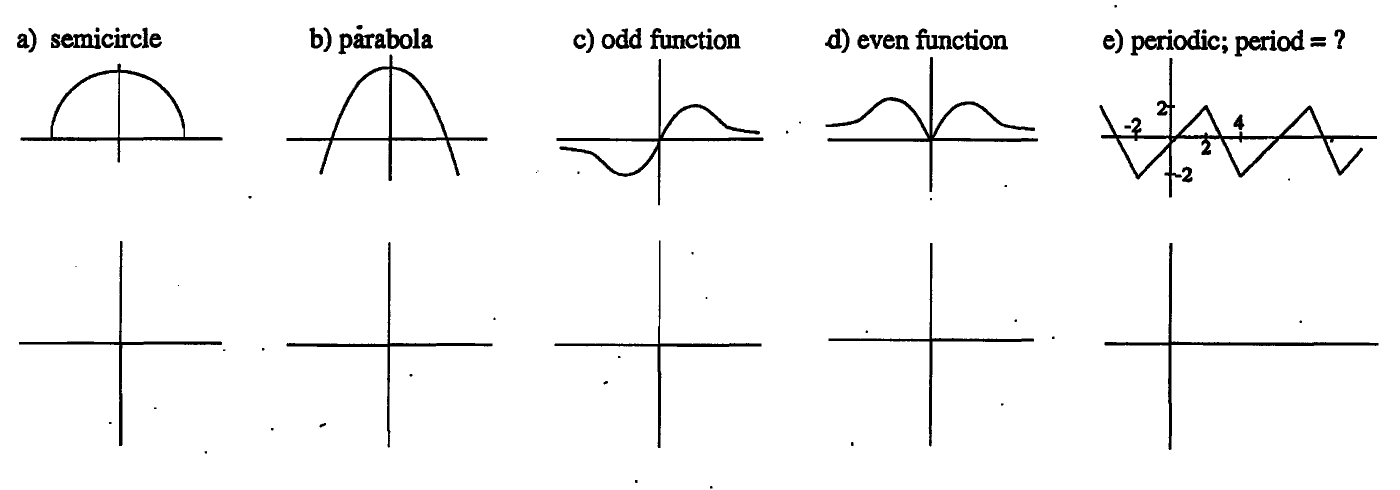
9. Problem 8
Show that
has a removable discontinuity at exists.
10. Problem 9
For which of the following should one use the one-sided limit? Evaluate it.
a)
b)
c)
d)
e)
11. Problem 10
Identify and give the type of the points of discontinuity of each of the following.
a)
b)
c)
d)
e) , for the in d)
f) , where
Practice this interactively
Free account · instant grading · spaced review that schedules itself.
Start this course for free