Calculus Volume 2 · free preview
Chapter 1 Problem Set. Integration
Problem set for this chapter. Integration.
1. How this assessment works
This lesson is a curated assessment adapted from MIT OpenCourseWare 18.01 Single Variable Calculus (Fall 2006), supplemented by a university mathematics question bank (https://ocw.mit.edu/courses/18-01-single-variable-calculus-fall-2006/), used under CC BY-NC-SA 4.0 for the MIT items. Work through the 10 problems in order, for each problem, type your reasoning in the answer box or write it on the handwriting pad, then submit it for AI grading.
How the grading works Every problem is graded by an AI mathematics teacher that reads the official solution shipped with the course. It checks your work criterion by criterion, awards partial credit for correct steps, and returns written feedback. Equivalent mathematics and valid alternative methods are accepted, a different route to the same result can still earn full marks.
If your answer is incomplete, the feedback names exactly which steps are missing, so you can correct them and try again.
2. Problem 1
Find the derivative of
3. Problem 2
Find
for
by implicit differentiation.
4. Problem 3
Find all points of the curve(s)
with horizontal tangent lines. (This is a collection of curves with a periodic, repeated pattern because the equation is unchanged under the transformations
and
5. Problem 4
Calculate
for the following functions.
a)
b)
c)
d)
6. Problem 5
a) Evaluate . Hint. Let , and use .
b) Deduce that .
7. Problem 6, Sketching nine graphs, monotonicity and roots
Sketch the graphs of the following. Find the intervals on which it is increasing and decreasing and decide how many solutions there are to . (Graphs need not reflect inflection points, which are discussed in 9-2).
a)
b)
c) and .
d)
e)
f)
g)
h)
i) and .
8. Problem 7, Strongest rectangular beam cut from a circular log
A beam with a rectangular cross-section is cut from a log with a circular cross-section. The strength of the beam is proportional to the horizontal dimension of the rectangle and to the cube of the vertical dimension of the rectangle, . Find the ratio which gives the strongest beam.
9. Problem 8, Height of a desk lamp maximizing illumination
You are going to mount a light on the wall behind your desk. The light at illuminates a point on the horizontal surface of the desk with an intensity inversely proportional to the square of the distance from to and proportional to sine of the angle between the ray from to and the horizontal surface. Fix a point on the desk 1 foot from the wall. Find the height of above the desk for which the intensity at is largest.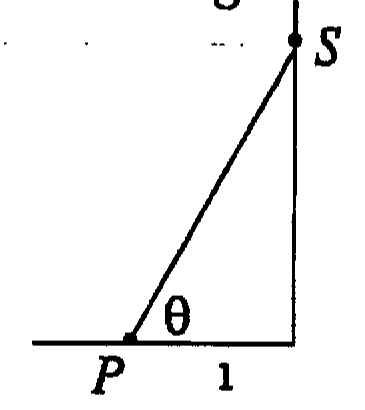
10. Problem 9, Law of reflection from the shortest path
A light ray reflected in a mirror travels the shortest distance between its starting point and its endpoint.
Suppose the ray starts at , and ends at the point inside the first quadrant, and being reflected when it hits the -axis (at the point , say).
Show that the two line segments forming its path make equal angles with the -axis, i.e., "the angle of incidence equals the angle of reflection."
11. Problem 10, Shortest road networks for four towns
- a) Show that the shortest collection of roads joining four towns at four corners of a unit square is given by roads that meet at angles. Use the variable as indicated on the picture.
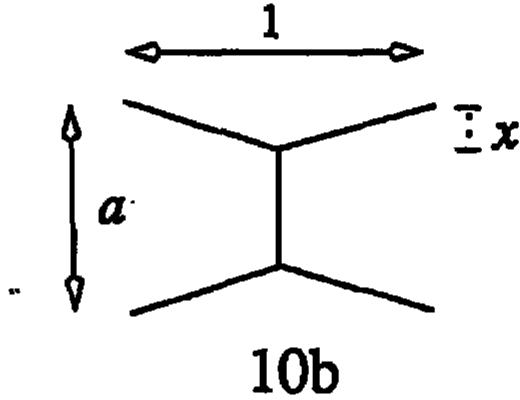
b) Find the shortest collection of roads in the shape indicated for towns at the four corners of a rectangle. Write down the formula for the length of the roads as a function of . Hint. Sometimes the answer is that the roads meet at angles, but only for certain values of .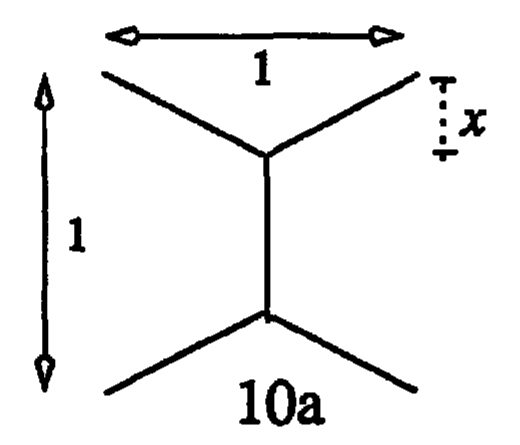
Practice this interactively
Free account · instant grading · spaced review that schedules itself.
Start this course for free