Calculus Volume 2 · free preview
Chapter 3 Problem Set. Techniques of Integration
Problem set for this chapter. Techniques of Integration.
1. How this assessment works
This lesson is a curated assessment adapted from MIT OpenCourseWare 18.01 Single Variable Calculus (Fall 2006), supplemented by a university mathematics question bank (https://ocw.mit.edu/courses/18-01-single-variable-calculus-fall-2006/), used under CC BY-NC-SA 4.0 for the MIT items. Work through the 10 problems in order, for each problem, type your reasoning in the answer box or write it on the handwriting pad, then submit it for AI grading.
How the grading works Every problem is graded by an AI mathematics teacher that reads the official solution shipped with the course. It checks your work criterion by criterion, awards partial credit for correct steps, and returns written feedback. Equivalent mathematics and valid alternative methods are accepted, a different route to the same result can still earn full marks.
If your answer is incomplete, the feedback names exactly which steps are missing, so you can correct them and try again.
2. Problem 1
a) Let be a given constant. Find in terms of the value of for which and both satisfy the equation
Use this value of in each of the following parts.
b) Show that is also a solution to the equation in (a), for any constants and .
c) Show that the function (whose graph is a sine wave with phase shift ) also satisfies the equation in (a), for any constant .
d) Show that the function in (c) is already included among the functions of part (b), by using the trigonometric addition formula for the sine function. In other words, given and , find values of and for which
3. Problem 2, Graph of the derivative; a rational function with a given graph
a) Trace a copy of the graph of the function below and draw the graph of the derivative directly underneath. Connect the inflection point to the corresponding point on the graph of the derivative with a vertical dotted line.
b) Find a rational function with a graph resembling the one below.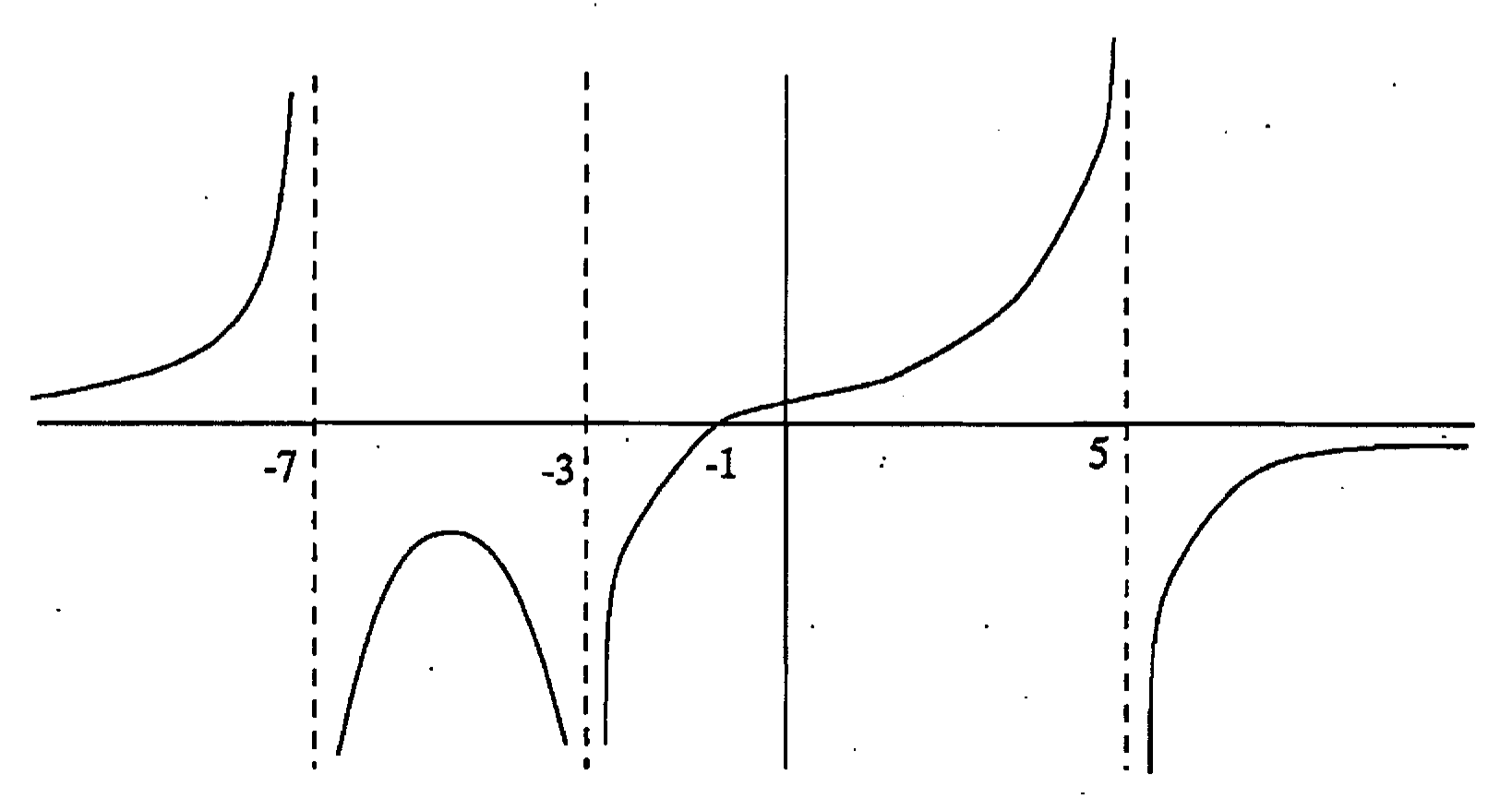
4. Problem 3, Maxima of $x^2\ln(1/x)$ and $-x\ln(2x)$
Find the maximum value and the location of the maximum for the following functions. (When , as . This follows from 2G-8 or from L'Hospital's rule in Section 6A.)
a) , for
b) , for
5. Problem 4, Roots of a polynomial and of its derivative
A polynomial of degree has at most distinct real roots, but it may have fewer-for instance, has no real roots at all. However, show that if does have distinct real roots, then has distinct real roots.
6. Problem 5, Three rules on four integrals
3G-1 Find approximations to the following integrals using four intervals using Riemann sums with left endpoints, using the trapezoidal rule, and using Simpson's rule. Also give numerical approximations to the exact values of the integrals given to see how good these approximation methods are.
a) ()
b) ()
c) (; cf. unit 5)
d) ()
7. Problem 6, Simpson's rule is exact for cubics
3G-2 Show that the value given by Simpson's rule for two intervals for the integral
gives the exact answer when . (Since a cubic polynomial is a sum of a quadratic polynomial and a polynomial , and Simpson's rule is exact for any quadratic polynomial, the result of this exercise implies by linearity (cf. Notes PI) that Simpson's rule will also be exact for any cubic polynomial.)
8. Problem 7, Estimating a sum of square roots
3G-3 Use the trapezoidal rule to estimate . Is your estimate too high or too low?
9. Problem 8, Estimating a sum of reciprocals
3G-4 Use the trapezoidal rule to estimate the sum of the reciprocals of the first integers. Is your estimate too high or too low?
10. Problem 9, When the trapezoidal rule is too low or too high
3G-5 If the trapezoidal rule is used to estimate the value of under what hypotheses on will the estimate be too low? too high?
11. Problem 10, Arclength of four plane curves
4F-1 Find the arclength of the following curves.
a) , .
b) , .
c) , .
d) , .
Practice this interactively
Free account · instant grading · spaced review that schedules itself.
Start this course for free