Calculus Volume 2 · free preview
Chapter 5 Problem Set. Sequences and Series
Problem set for this chapter. Sequences and Series.
1. How this assessment works
This lesson is a curated assessment adapted from MIT OpenCourseWare 18.01 Single Variable Calculus (Fall 2006), supplemented by a university mathematics question bank (https://ocw.mit.edu/courses/18-01-single-variable-calculus-fall-2006/), used under CC BY-NC-SA 4.0 for the MIT items. Work through the 12 problems in order, for each problem, type your reasoning in the answer box or write it on the handwriting pad, then submit it for AI grading.
How the grading works Every problem is graded by an AI mathematics teacher that reads the official solution shipped with the course. It checks your work criterion by criterion, awards partial credit for correct steps, and returns written feedback. Equivalent mathematics and valid alternative methods are accepted, a different route to the same result can still earn full marks.
If your answer is incomplete, the feedback names exactly which steps are missing, so you can correct them and try again.
2. Problem 1, Convergence of fifteen series
Decide whether the following series are convergent or divergent; indicate reasoning. (Do not evaluate the sum.)
a) ; use comparison with an integral.
b) ; consider the cases and .
c)
d)
e) Hint. Combine pairs of consecutive terms to take advantage of the cancellation. Then use comparison.
f)
g)
h)
i)
j)
k)
l)
m)
n)
o)
3. Problem 2, A repeating decimal as a rational number
Find the rational number represented by the infinite decimal.21111....
4. Problem 3, A geometric series with parameter $x$
For which
does the series
converge? For these values, find its sum
5. Problem 4, Total distance travelled by a bouncing ball
A ball is dropped from height
each time it lands, it bounces back
of the height from which it previously fell. What is the total distance (up and down) the ball travels?
6. Problem 5, The integral test
Using the integral test, tell whether the following series converge or diverge; show work or reasoning.
a)
b)
c)
d)
e)
f)
(In the last two, the answer depends on the value of the parameter
7. Problem 6, The limit comparison test
Using the limit comparison test, tell whether each series converges or diverges; show work or reasoning. (For some of them, simple comparison works.)
a)
b)
c)
d)
e)
f)
g)
h)
8. Problem 7, If $\sum a_n$ converges then $\sum \sin a_n$ converges
Prove that if and converges, then also converges.
9. Problem 8, Absolute convergence by the ratio test
Using the ratio test, or otherwise, determine whether or not each of these series is absolutely convergent. (Note that .)
a)
b)
c)
d)
e)
f) ; use
g)
h)
i)
10. Problem 9, Conditionally convergent or divergent?
For those series in 7C-4 which are not absolutely convergent, tell whether they are conditionally convergent or divergent.
11. Problem 10, Water level in a trapezoidal trough
A trough is filled with water at a rate of 1 cubic meter per second. The trough has a trapezoidal cross section with the lower base of length half a meter and one meter sides opening outwards at an angle of from the base. The length of the trough is 4 meters. What is the rate at which the water level is rising when is one half meter?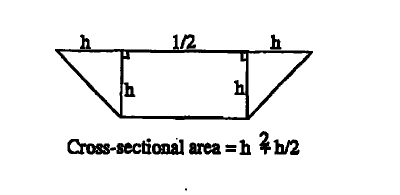
12. Problem 11, Six series, convergence and sums
Do the following series converge or diverge? Give reason. If the series converges, find its sum.
a)
b)
c)
d)
e)
f)
13. Problem 12, Total distance travelled by a bouncing ball
A ball is dropped from height
each time it lands, it bounces back
of the height from which it previously fell. What is the total distance (up and down) the ball travels?
Practice this interactively
Free account · instant grading · spaced review that schedules itself.
Start this course for free