线性代数 · free preview
MIT 18.06 Final Exam
The course final: LU factors, least squares, inverses, Markov matrices, rotations and reflections, Gram-Schmidt, determinants and similarity.
1. MIT 18.06 Final Exam — how this assessment works
This lesson reproduces the Exam “MIT 18.06 Final Exam” from MIT OpenCourseWare 18.06 Linear Algebra (Spring 2010) (https://ocw.mit.edu/courses/18-06-linear-algebra-spring-2010/), licensed under CC BY-NC-SA 4.0. Work through 9 problems in order: type your reasoning in the answer box or write it on the handwriting pad, then submit for AI grading.
How the grading works Every problem is graded by an AI mathematics teacher that reads the official solution shipped with the course. It checks your work criterion by criterion, awards partial credit for correct steps, and returns written feedback. Equivalent mathematics and valid alternative methods are accepted — a different route to the same result can still earn full marks.
If your answer is incomplete, the feedback names exactly which steps are missing, so you can correct them and try again.
2. MIT 18.06 FINAL Problem 1 — LU factorization, rref, and nullspace of a 3 by 4 matrix (12 pts)
This question is about the matrix
(a) Find a lower triangular and an upper triangular so that .
(b) Find the reduced row echelon form . How many independent columns in ?
(c) Find a basis for the nullspace of .
(d) If the vector is the sum of the four columns of , write down the complete solution to .
3. MIT 18.06 FINAL Problem 2 — Least squares fit of the curve $y = C + D2^t$ (11 pts)
This problem finds the curve which gives the best least squares fit to the points .
(a) Write down the 3 equations that would be satisfied if the curve went through all 3 points.
(b) Find the coefficients and of the best curve .
(c) What values should have at times so that the best curve is ?
4. MIT 18.06 FINAL Problem 3 — Determining $A$ from the equations $Av_i = b_i$ (11 pts)
Suppose for the vectors and in . Put the 's into the columns of and put the 's into the columns of .
(a) Write those equations in matrix form. What condition on which vectors allows to be determined uniquely? Assuming this condition, find from and .
(b) Describe the column space of that matrix in terms of the given vectors.
(c) What additional condition on which vectors makes an invertible matrix? Assuming this, find from and .
5. MIT 18.06 FINAL Problem 4 — Steady state of a preference chain, a $2 \times 2$ system of ODEs, and straight-line trajectories (11 pts)
(a) Suppose is the fraction of MIT students who prefer calculus to linear algebra at year . The remaining fraction prefers linear algebra.
At year , of those who prefer calculus change their mind (possibly after taking 18.03). Also at year , of those who prefer linear algebra change their mind (possibly because of this exam).
Create the matrix to give and find the limit of as .
(b) Solve these differential equations, starting from , :
(c) For what initial conditions does the solution to this differential equation lie on a single straight line in for all ?
6. MIT 18.06 FINAL Problem 5 — A $120^\circ$ rotation about the axis $x = y = z$ and a plane projection (11 pts)
(a) Consider a rotation around the axis . Show that the vector is rotated to the vector . (Similarly is rotated to and is rotated to .) How is related to the vector along the axis?
(b) Find the matrix that produces this rotation (so is the rotation of ). Explain why . What are the eigenvalues of ?
(c) If a 3 by 3 matrix projects every vector onto the plane , find three eigenvalues and three independent eigenvectors of . No need to compute .
7. MIT 18.06 FINAL Problem 6 — Eigenvalues of $A^T A$ and $AA^T$, Gram-Schmidt, and positive definiteness (11 pts)
This problem is about the matrix
(a) Find the eigenvalues of and also of . For both matrices find a complete set of orthonormal eigenvectors.
(b) If you apply the Gram-Schmidt process (orthonormalization) to the columns of this matrix , what is the resulting output?
(c) If is any by matrix with , tell me why cannot be positive definite. Is always positive definite? (If not, what is the test on ?)
8. MIT 18.06 FINAL Problem 7 — Determinants of three related $4 \times 4$ matrices (11 pts)
This problem is to find the determinants of
(a) Find det and give a reason.
(b) Find the cofactor and then find det . This is the volume of what region in ?
(c) Find det for any value of . You could use linearity in row 1.
9. MIT 18.06 FINAL Problem 8 — Powers of similar matrices and the space of $S$-diagonalized matrices (11 pts)
(a) When is similar to , prove this statement:
If when , then also .
(b) Suppose is a fixed invertible 3 by 3 matrix.
This question is about all the matrices that are diagonalized by , so that is diagonal. Show that these matrices form a subspace of 3 by 3 matrix space. (Test the requirements for a subspace.)
(c) Give a basis for the space of 3 by 3 diagonal matrices. Find a basis for the space in part (b) — all the matrices that are diagonalized by .
10. MIT 18.06 FINAL Problem 9 — A square network: incidence matrix, Laplacian, and the currents (11 pts)
This square network has 4 nodes and 6 edges. On each edge, the direction of positive current is from lower node number to higher node number. The voltages at the nodes are .
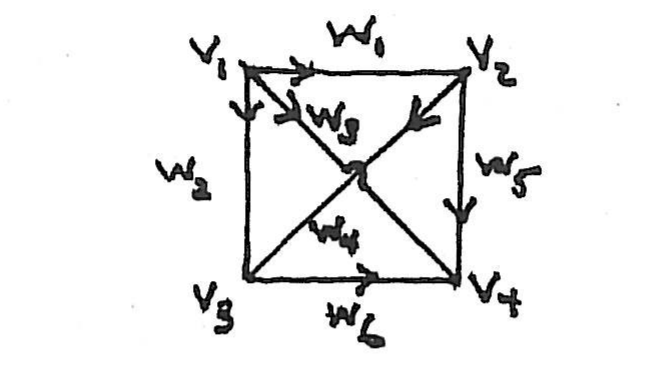
(a) Write down the incidence matrix for this network (so that gives the 6 voltage differences like across the 6 edges). What is the rank of ? What is the dimension of the nullspace of ?
(b) Compute the matrix . What is its rank? What is its nullspace?
(c) Suppose and . If each edge contains a unit resistor, the currents on the 6 edges will be by Ohm's Law. Then Kirchhoff's Current Law (flow in=flow out at every node) gives which means . Solve for the unknown voltages and . Find all 6 currents to . How much current enters node 4?
Practice this interactively
Free account · instant grading · spaced review that schedules itself.
Start this course for free